When “Any Update?” Becomes Your Daily Workflow
If you work in logistics, you’ve probably seen the same message more times than you can count:
“Any update on the shipment?”
It comes from customers, partners, internal teams, sometimes all at once.
The frustrating part isn’t the question. It’s the process behind answering it. You check your system, confirm with operations, maybe send an email, and finally reply. By then, another update might already be pending.
Now multiply that by dozens of shipments.
This is where most logistics teams lose time, not in operations, but in communication gaps.
And that’s exactly why integrating WhatsApp into your freight tracking workflow is becoming a practical solution, not just for convenience, but for operational efficiency.
Why WhatsApp is Already Part of Your Supply Chain?
Whether officially supported or not, WhatsApp is already deeply embedded in logistics operations.
Teams use it for:
- Sharing shipment updates
- Coordinating with drivers and agents
- Sending documents quickly
- Responding to customer queries
The issue isn’t usage, it’s lack of structure.
Most WhatsApp communication happens outside your systems. That means:
- Updates are manual
- Information gets lost in chats
- Data is not synchronized
- Teams rely on memory instead of systems
This creates inconsistency and delays, especially when managing multiple shipments.
The Shift: From Messaging Tool to Visibility Channel
Connecting WhatsApp to your freight tracking workflow changes its role completely.
Instead of being just a messaging app, it becomes a real-time visibility channel.
This means:
- Shipment updates are triggered automatically
- Messages are linked to live data
- Communication reflects the actual system status
- Teams don’t need to manually send updates
In simple terms, WhatsApp stops being a side tool and becomes part of your operational workflow.
What Changes When WhatsApp is Integrated?
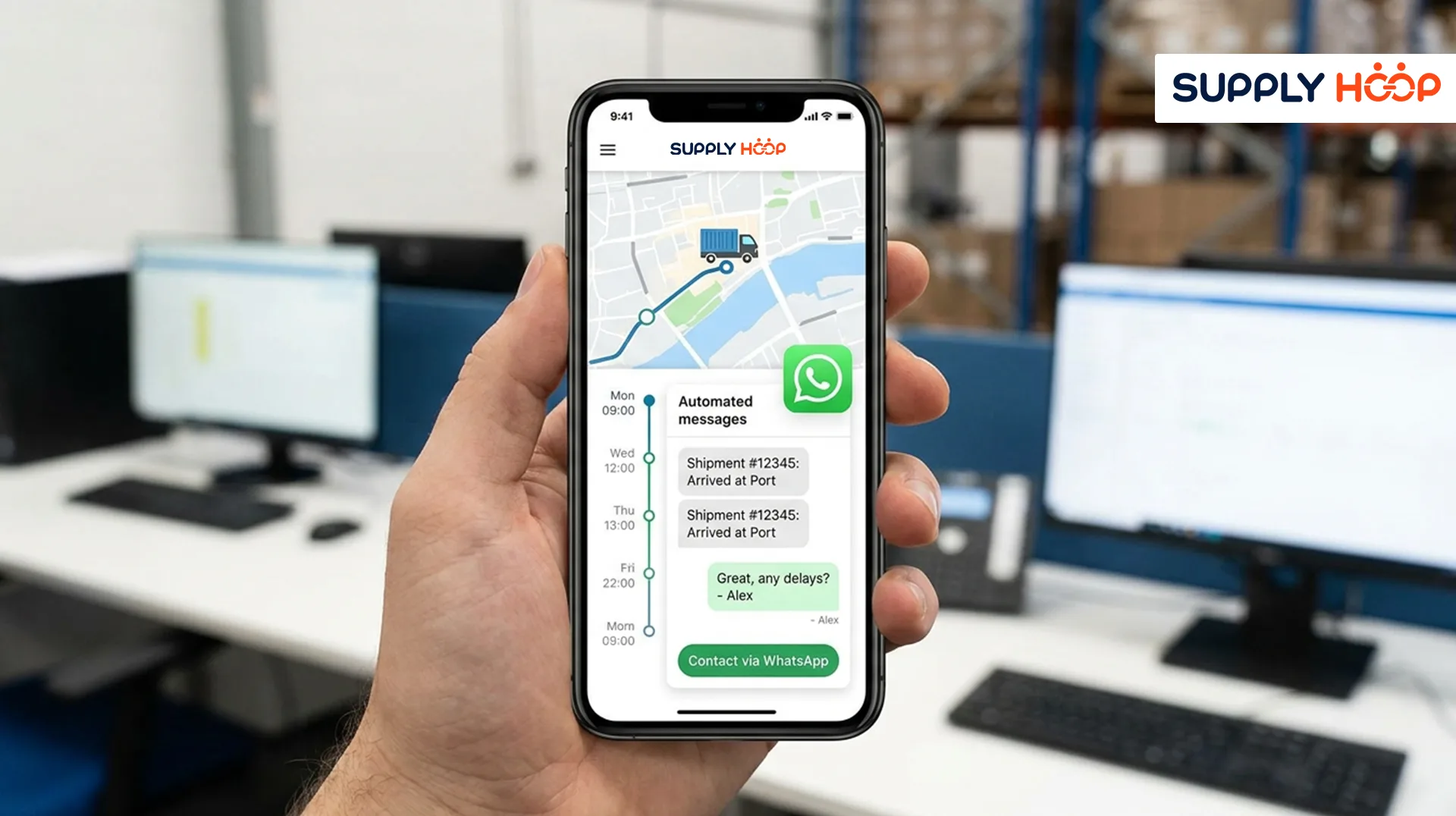
Once WhatsApp is connected to your logistics systems through a mobile app, the way information flows improves significantly.
Instead of waiting for someone to respond, updates happen automatically.
For example:
- When a shipment is dispatched, a message is sent instantly
- When there’s a delay, customers are notified immediately
- When documents are ready, alerts are triggered
- When milestones are completed, updates are shared in real time
This reduces the need for constant follow-ups.
How does the Integration Actually Work?
From a practical standpoint, integrating WhatsApp into your freight tracking workflow involves connecting your logistics platform (like CargoWise or any ERP/TMS) to a mobile visibility solution that supports messaging integration.
The process typically includes:
- Connecting your system data to a centralized visibility platform
- Mapping shipment milestones to notification triggers
- Linking customer or partner contact details
- Enabling automated message flows through WhatsApp
Once set up, the system handles updates automatically, based on real-time shipment data.
Where WhatsApp Adds Immediate Value?
The biggest impact of WhatsApp integration is seen in everyday operational scenarios.
1. Real-Time Shipment Updates
Customers no longer need to ask for updates. They receive them as they happen.
This includes:
- Shipment departures and arrivals
- ETA changes
- Delays or disruptions
- Delivery confirmations
It improves transparency and reduces communication friction.
2. Faster Exception Handling
When something goes wrong, speed matters.
Instead of waiting for updates to be shared manually, WhatsApp alerts ensure that:
- Teams are informed immediately
- Customers are notified proactively
- Actions can be taken faster
This helps reduce escalation and improve response time.
3. Simplified Customer Communication
Customer service teams spend a significant amount of time answering repetitive questions.
With WhatsApp integration:
- Common queries are addressed automatically
- Updates are consistent across all stakeholders
- Communication becomes more efficient
This allows teams to focus on more critical tasks.
4. Document and Approval Notifications
Logistics workflows often depend on documents, HBLs, invoices, approvals, and more.
WhatsApp can be used to:
- Notify when documents are ready
- Alert teams for pending approvals
- Share important updates instantly
This ensures that workflows don’t get delayed due to missed communication.
Why Mobile Integration Makes It More Powerful?
WhatsApp integration becomes even more effective when combined with a mobile visibility app.
This allows logistics professionals to:
- Monitor shipments in real time
- Respond to messages instantly
- Access operational data alongside communication
- Stay connected while on the move
It creates a seamless connection between visibility and action.
The Real Impact on Operations
When WhatsApp is fully integrated into your freight tracking workflow, the impact goes beyond communication.
You start to see:
- Fewer follow-up messages and emails
- Faster response to customer queries
- Improved operational efficiency
- Better alignment across teams
- Stronger customer trust
It reduces noise and brings clarity to daily operations.
What to Consider Before Implementing?
While the benefits are clear, successful implementation depends on a few key factors:
- Ensuring data accuracy in your core systems
- Defining clear notification rules
- Avoiding overloading users with unnecessary alerts
- Maintaining security and access control
The goal is not to send more messages, but to send the right messages at the right time.
Why This Matters in Today’s Logistics Environment?
In 2026, logistics is no longer just about moving cargo, it’s about managing expectations in real time.
Customers expect:
- Instant updates
- Accurate information
- Proactive communication
Freight forwarders who can deliver this experience stand out.
WhatsApp integration helps bridge the gap between operations and communication, ensuring that visibility reaches the people who need it, when they need it.
Conclusion
Logistics teams don’t need more communication channels, they need better-connected ones.
By integrating WhatsApp into your freight tracking workflow, you transform everyday messaging into a structured, real-time visibility tool.
It reduces manual effort, improves response time, and enhances the overall customer experience.
If you’re looking to simplify communication and gain true end-to-end supply chain visibility, now is the time to take the next step.
Book a demo today and see how mobile-driven visibility with WhatsApp integration can transform your freight operations.